
Poetry for our time
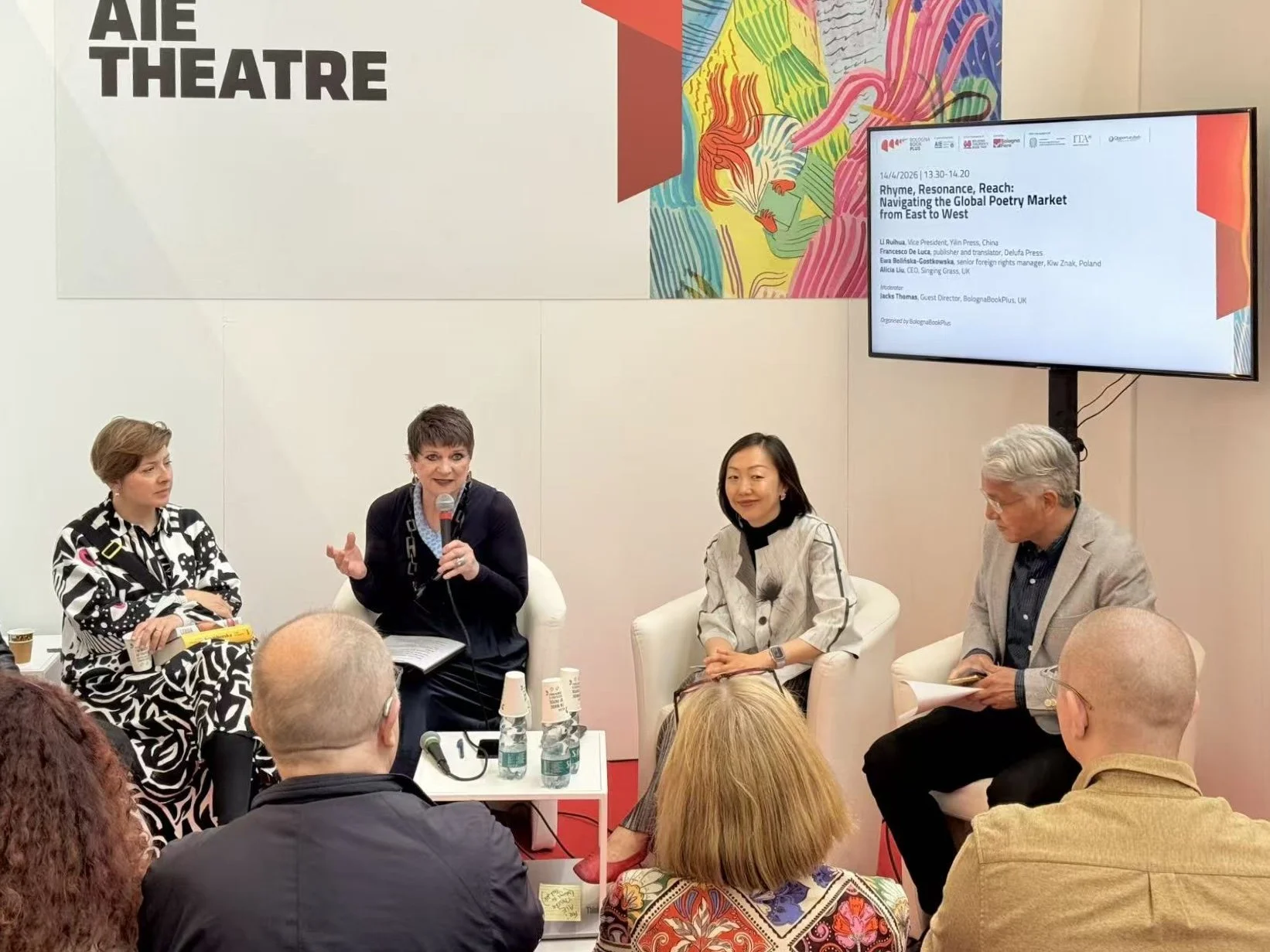
Stepping onto the stage at Bologna Book Plus this week for the "Poetry – Rhythm, Renaissance and Reach" panel, I was struck by the central provocation of our discussion: are we witnessing a genuine poetic renaissance, or simply an explosion of quantity enabled by the digital age? The far reaching and passionate discussion, nimbly chaired by Jacks Thomas, Guest Director of Bologna Book Plus, made it clear that while the medium is shifting across the diverse market of the UK, Italy, Poland and China, a plethora of poetry for our time may be exactly the answer.
“In an age of existential anxiety, sharing something beautiful is the most effective medicine we have.”
Renaissance or Just a Flood?
The debate began with a sharp distinction between quality and volume. Francesco da Luca, poet and founder of Italy’s De Lufa Press, offered the most skeptical - and perhaps most purist-view, suggesting we are in a period of "turbulence" rather than a rebirth. For Francesco, the "emotional self-expression" found on social media often fails to meet the definition of real poetry; he argued that while genuine poetic energy exists in chaotic times, it is often buried beneath the digital noise.
This led us directly into the "Instapoetry" effect. We discussed how platforms like Instagram, TikTok, RED and WeChat have democratised expression but also fundamentally changed the structural composition of the craft. The "internet floods the field," as the panel noted, prioritising brevity and emotional immediacy - what Francesco called "social media venting" - over traditional craft. However, the consensus was that this flood makes the publisher’s role as a curator more vital, not less.
The 180,000-Copy Success Story
Nowhere is this quantity more staggering than in China. Li Ruihua, Vice President of Yilin Press, an imprint of of Phoenix Publishing, shared a data point from Chinese technology titan Tencent that left the room reeling: the volume of contemporary poetry created in China every single day now exceeds the entire body of classical Chinese poetry ever written.
Yet, within this mountain of data, there is a deep hunger for international voices. A standout example is the contemporary Syrian poet Adonis; his Arabic collection My Loneliness is a Garden (published in China by Yilin Press) has sold over 180,000 copies in translation. This success, Li Ruihua noted, was driven by a scholar’s discovery and proves that great poetry travels across languages and cultures regardless of its origin. In China, social media is not just "noise" - it is a discovery tool where poets who build digital followings can transition to selling millions of collectible physical books.
……
Read the full story by Alicia Liu on BOOKBRUNCH